
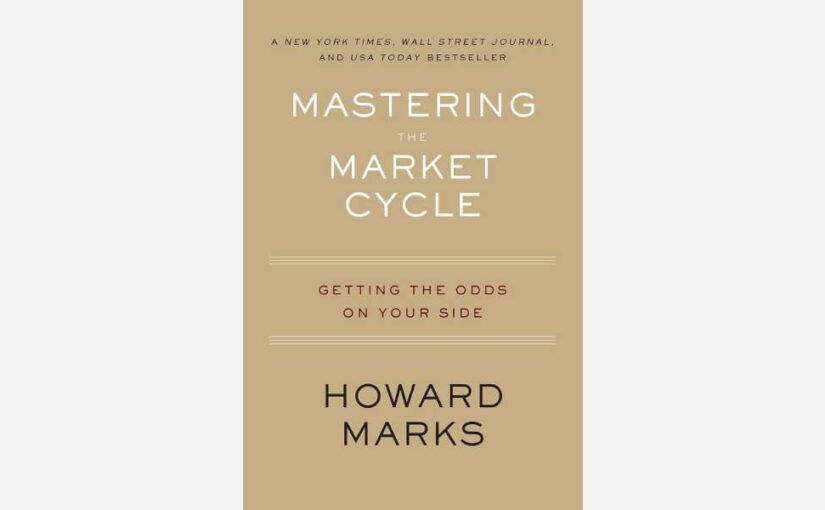
Hello and Welcome. This page is a collection of 18 quotes from Mastering the Market Cycle book by Howard Marks that I liked and saved while reading this book. I hope you will like these quotes too.
By the way, I am Deepak Kundu, an avid book reader, quotes collector and blogger.
Quotes on Market Cycles
- In business, financial and market cycles, most excesses on the upside – and the inevitable reactions to the downside, which also tend to overshoot – are the result of exaggerated swings of the pendulum of psychology. Thus understanding and being alert to excessive swings is an entry-level requirement for avoiding harm from cyclical extremes, and hopefully for profiting from them.
- How you deal with cycles is one of the most important things in investing. Cycles will happen to you. What you do in response is key.
- One of the best ways to enjoy the skewed distribution of outcomes that marks superior investors is to get the market’s tendency on your side. The outcome will never be under your control, but if you invest when the market’s tendency is biased toward favorable, you’ll have the wind at your back, and if the tendency is biased toward unfavorable, the reverse will be true. Skillful analysis of cycles can give you a better-than-average understanding of the market’s likely tendency and thus enable you to improve your chances of properly positioning your portfolio for what lies ahead.
- The tendency of people to go to excess will never end. And thus, since those excesses eventually have to correct, neither will the occurrence of cycles. Economies and markets have never moved in a straight line in the past, and neither will they do so in the future. And that means investors with the ability to understand cycles will find opportunities for profit.
Quotes on Investing
- Investment success is like the choosing of a lottery winner. Both are determined by one ticket (the outcome) being pulled from a bowlful (the full range of possible outcomes). In each case, one outcome is chosen from among the many possibilities. Superior investors are people who have a better sense for what tickets are in the bowl, and thus for whether it’s worth participating in the lottery. In other words, while superior investors – like everyone else – don’t know exactly what the future holds, they do have an above-average understanding of future tendencies.
- The risk in investing doesn’t come primarily from the economy, the companies, the securities, the stock certificates or the exchange buildings. It comes from the behavior of the market participants. So do most of the opportunities for exceptional returns.
Other Quotes
- The greatest source of investment risk is the belief that there is no risk. Widespread risk tolerance – or a high degree of investor comfort with risk – is the greatest harbinger of subsequent market declines.
- When investors in general are too risk-tolerant, security prices can embody more risk than they do return. When investors are too risk-averse, prices can offer more return than risk.
- During panics, people spend 100% of their time making sure there can be no losses … at just the time that they should be worrying instead about missing out on great opportunities. In times of extreme negativism, exaggerated risk aversion is likely to cause prices to already be as low as they can go; further losses to be highly unlikely; and thus the risk of loss to be minimal.
- It seems to be hard-wired into most people’s psyches to become more optimistic and risk-tolerant when things are going well, and then more worried and risk-averse when things turn downward. That means they’re most willing to buy when they should be most cautious, and most reluctant to buy when they should be most aggressive. Superior investors recognize this and strive to behave as contrarians.
- Superior investing doesn’t come from buying high-quality assets, but from buying when the deal is good, the price is low, the potential return is substantial, and the risk is limited. These conditions are much more the case when the credit markets are in the less-euphoric, more-stringent part of their cycle. The slammed-shut phase of the credit cycle probably does more to make bargains available than any other single factor.
- Few things are as costly as paying for potential that turns out to have been overrated.
- The early discoverer – who by definition has to be that rare person who sees the future better than others and has the inner strength to buy without validation from the crowd – garners undiscovered potential at a bargain price. But every investment trend eventually is overdone and bid up too far, so that the buyer in the end pays up for potential that is overrated. He ends up with capital punishment, not capital appreciation.
- I don’t believe in forecasting. Very few people can know enough about what the future holds for it to add to their returns, and the record of most forecasters – in terms of both predicting events better than others and having better investment performance than others as a result – is quite lackluster. A few people become famous in each period for singular, spectacular successes, but usually their next correct forecast doesn’t come for many years.
- It’s not what you buy that determines your results, it’s what you pay for it. And what you pay – the security’s price and its relationship to intrinsic value – is determined by investor psychology and the resulting behavior. The key to being able to behave in a way that’s appropriate given the market climate lies significantly in assessing psychology and the behavior of others. You have to know whether the market is red-hot and thus overpriced, or frigid and thus a bargain.
- It’s important to note that exiting the market after a decline – and thus failing to participate in a cyclical rebound – is truly the cardinal sin in investing. Experiencing a mark-to-market loss in the downward phase of a cycle isn’t fatal in and of itself, as long as you hold through the beneficial upward part as well. It’s converting that downward fluctuation into a permanent loss by selling out at the bottom that’s really terrible.
- We can’t create great opportunities to time the market through our understanding of cycles. Rather, the market will decide when we’ll have them. Remember, when there’s nothing clever to do, the mistake lies in trying to be clever.
- There’s little that can make investing as easy as having a market largely to oneself. It beats the heck out of trying to wring decent returns from a market that everybody has discovered, figured out, taken to and crowded into.